I Tried Every Running Coach: Why I Built Run Plan After Garmin Coach, Runna, ChatGPT, and more
I tried every training method and finally built the AI running coach I wish existed




I'm Romain, the founder of Run Plan. Like most runners, I've tried many ways to get a structured training plan from static PDF plans, Garmin Coach, apps like Runna, and even ChatGPT. Each one had it's flaws, but ChatGPT has been way better than I had expected.
However it was missing some key features that I needed to make it a truly effective running coach. This is my honest journey through different training approaches, the frustrations I faced, and why I eventually built Run Plan to solve the problems none of them could. If you've ever felt like your training plan doesn't quite fit your life, you'll understand exactly what I mean.
Starting Point: Why Static PDF Plans Fall Short

Like many runners, my journey started with static PDF training plans you could find online or in running magazines. These were usually 8-12 week programs targeting a specific distance like a 5K or marathon.
The good thing? They helped me understand what proper training structure looks like: intervals, tempo runs, long runs, and recovery days. For a beginner, having that framework was incredibly valuable. I learned the fundamentals of periodization and why you need different types of runs.
But the limitations became obvious quickly. These plans don't know anything about your current fitness level. They assume you're starting from the same baseline as everyone else. Miss a week? Tough luck, the plan doesn't adjust. Want to train for multiple races? You're out of luck. The rigidity meant I was either overreaching or undertraining most of the time.
Classic Apps Disappointment: Runna and Campus Coach
So I moved to dedicated running apps. I tried Runna first, then Campus Coach. These seemed more sophisticated: better interfaces, more structured plans, and they integrated with Garmin.
But the flexibility issues persisted. Campus Coach only let me set one primary goal at a time. I couldn't plan for multiple races across a season. If I wanted to adjust my target time myself, that wasn't an option, the app decided what was realistic based on its algorithm.
And the manual work was tedious. Every single day, I had to remember to manually send my workout to my Garmin watch. Wake up, check the app, tap 'send to Garmin,' then go run. It was one extra step, but after months of doing it daily, it got annoying.
But the real problem? The workouts didn't feel adapted to me. They seemed generic, like templates slightly tweaked for my pace. I wasn't getting the personalization I was hoping for. The apps knew my pace and heart rate, but they didn't seem to really understand my training history or adapt meaningfully to how I was progressing.
The Garmin Coach Problem: Convenient but Inflexible
When I got my first Garmin watch, I was excited to try Garmin Coach. Finally, something integrated directly into my device! I wouldn't need to look at a PDF or phone app, my workout would just be there when I opened my watch in the morning.
And honestly, that part was great. Waking up and seeing my workout already on my watch was convenient. No thinking, just press start and go. For someone who values simplicity, this was a huge win.
But Garmin Coach had some serious issues that drove me crazy:
No visibility on future workouts
I had no idea what was coming next week or next month. Planning my schedule around training became impossible. Could I travel next week? Is it a hard week? I had no clue until the day before.
Zero flexibility
The plan was set in stone. Got injured? Traveling? Life got busy? Too bad. You can't ask for adjustments or explain your situation. The coach doesn't listen, it just follows its algorithm blindly.
It made me run more often, but shorter and slower
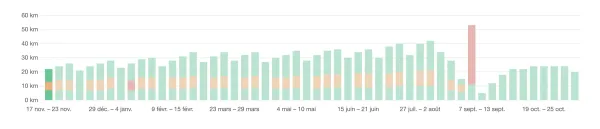
Garmin Coach seemed obsessed with frequency over quality. I was running almost every day, but the sessions were short and slow. My weekly volume increased, but my fitness didn't. It felt like I was doing a lot of 'junk miles' that weren't making me faster.
The most annoying thing: it changed schedules without asking
This was the deal-breaker. I'd plan my week, knowing I had a threshold session on Thursday. Then Wednesday night, I'd check my watch and suddenly Thursday's workout was gone, replaced with an easy run. Or sometimes a hard session would just disappear entirely. No explanation, no warning. It was like having a coach who randomly changes your plan and doesn't tell you why.
The convenience was there, but the lack of control and predictability made it frustrating. I needed something more flexible.
ChatGPT Surprised Me (But It Still Wasn't Enough)
A few months ago, I had a crazy idea: what if I used ChatGPT to create my training plan? I'd heard people using it for coding, writing, and problem-solving. Why not running?
I was genuinely surprised at how good it was. I uploaded screenshots of my recent runs from Strava, explained my goals, and told it about my schedule. ChatGPT created a detailed, thoughtful training plan that actually made sense. It could plan for long-term goals: an entire season with multiple races. It understood how to adapt the plan when I missed workouts or needed to shift things around.
I could even discuss my workouts with it afterward. 'That tempo run felt harder than expected' - ChatGPT would analyze why and adjust the next week accordingly. It felt like having a coach who actually listened and adapted.
But there were three major annoyances that killed the experience:
It sometimes forgot my workouts
ChatGPT's memory isn't perfect, especially in long conversations. Halfway through my training block, it would forget that I was recovering from a specific injury or that I preferred long runs on Sundays. I'd have to constantly remind it of context it should have remembered. For a long-term training plan spanning months, this was a real problem.
I had to manually feed it data
Every time I wanted to update my plan, I had to take screenshots of Garmin or Strava and upload them. Transcribing pace, heart rate, and perceived exertion manually. It was a lot of work, and the friction meant I often didn't update my plan as frequently as I should have.
Manual entry into Garmin every single day
ChatGPT gave me a static PDF or document. Every morning, I'd have to manually enter that day's workout into my Garmin watch. The workout details, target paces, intervals - all typed in manually. After doing this daily for weeks, I realized this was unsustainable. The whole point of automation is to remove manual work, not create more of it.
ChatGPT showed me the potential of AI-powered coaching. But it wasn't quite there: it lacked consistency, automation, and seamless device integration. That's when I realized: someone needed to build a dedicated AI running coach that combines ChatGPT's intelligence with the automation and consistency that serious training requires.
Here's the Best AI Running Coach: Why I Built Run Plan
This is why I created Run Plan. It's the AI running coach that builds on everything I learned from ChatGPT: the personalization, the adaptability, the ability to plan long-term and multiple goals. But it solves all the problems that made ChatGPT impractical.
Perfect consistency: Run Plan never forgets. Your entire training history, goals, injury concerns, and preferences are permanently stored. The AI remembers that you're recovering from that meniscus tear, that you prefer long runs on Sundays, and how you've been progressing over the past three months. This consistency is crucial for effective long-term planning.
Automatic device integration: Connect your Garmin or Strava once, and that's it. Every workout automatically syncs. Your daily training session appears on your watch without you lifting a finger. No more manual screenshots, no more typing workouts into your watch every morning.
Real-time feedback and adaptation: After every run, Run Plan analyzes your performance: pace, heart rate zones, perceived exertion, and recovery metrics. The next week's plan automatically adapts based on what actually happened. Struggled with yesterday's tempo run? Tomorrow's easy run might be shortened. Showing signs of overreaching? Intensity gets dialed back automatically.
If you've struggled with rigid plans, manual data entry, or coaches that don't adapt, you'll understand why I built this. Run Plan is the solution to the problems I faced, and probably the ones you're facing too.